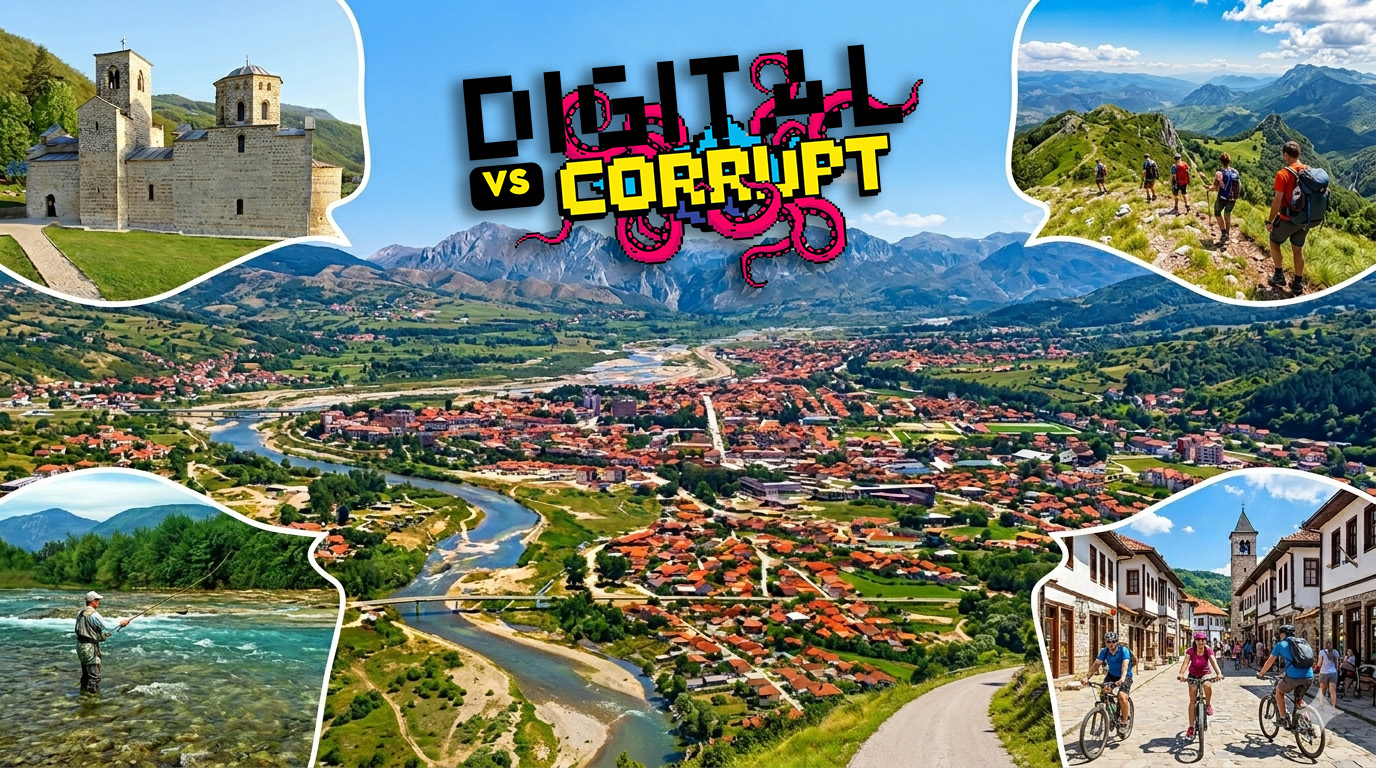
The EPEKA Association invites its members to apply (send your application to epeka@epeka.si) for the international Erasmus+ training, which will take place in Montenegro. The training is intended for youth workers and active individuals.
The DigitalVScorrupt project is aligned with the priorities of the European Commission, which are in line with the objectives of the Lisbon Treaty and the ongoing agenda 2019-2024. The project comes at a time when the EU is investing heavily in the UK, as evidenced by the EU-Western Balkans Summit in Tirana in December 2022, which highlighted a nearly €30 billion economic and investment plan for the region.
In the face of the energy crisis, the EU is working to improve the quality of life in the Balkans. Non-formal education, which is the cornerstone of the DigitalVScorrupt project, is key to these efforts, as it seeks to foster the EU’s core values and the rule of law. Digital tools, such as the ERAR system for monitoring public money remittances, developed by the Jožef Stefan Institute, will play a key role in preventing corruption.
DigitalVScorrupt is an extension of the previous successful Erasmus+ project and builds on a history in which more than 2000 young people have been involved in non-formal education on the topic of corruption. The project is based on cross-sectoral cooperation involving long-term and emerging partners from different sectors and backgrounds, ensuring a broad and inclusive approach.
The project’s partnership is designed to reflect inclusion and diversity and involves organisations representing the LGBTQ community and Roma networks to ensure that the consortium represents a broad spectrum of society.
The DigitalVScorrupt project is a comprehensive initiative focused on the endemic issue of corruption through educational and digital means, with a strong focus on youth involvement, cross-sectoral cooperation and the promotion of EU values. Its strategic approach to non-formal education and digital surveillance makes it a pioneering project in the fight against corruption, which aims to create more transparent, democratic and fair societies in the EU and the UK.
General objectives and specific objectives of the “DigitalVScorrupt” project: which aims to protect and promote the European way of life by upholding EU values and fighting corruption, which is recognised as a serious threat to the rule of law in the EU and beyond. The scope of the project has been broadened to cover a wider range of activities and to include a wider audience, including vulnerable groups, in non-formal education programmes. The aim is to improve the quality of life of Europeans through the use of youth work, non-formal learning and digital tools in the fight against corruption.
Although the project is not directly mentioned in the Erasmus+ Programme Guide, it acknowledges that corruption is a pervasive concern, as confirmed by Eurobarometer surveys, which show that a large majority of EU citizens believe that corruption is widespread and are pessimistic about the effectiveness of national anti-corruption measures. This belief has been further exacerbated by recent corruption scandals involving Members of the European Parliament.
A report by Transparency International reports that several countries in the Western Balkans have been assessed as having unfavourable corruption ratings and highlights the urgent need for intervention in these regions.
The project design methodically took into account the needs of various stakeholders, including youth workers and young people in the EU and the UK, organisations working with young people, and young people themselves. These needs range from acquiring competences and tools to fight corruption, expanding professional networks and developing new approaches to tackling corruption. The aim is to establish strong networks between the EU and the UK, share good practices and use ICT tools to monitor public spending.
In addition, the project aims to increase the capacity of organisations serving young people, especially those facing challenges, through the use of non-formal learning and mobility programmes. This is intended to ensure the active participation of young people in society and to recognise the benefits of joining the EU.
To achieve these goals, the project has outlined a series of activities, including meetings, training courses, workshops, the production of educational videos, and the development of toolkits and manuals. The activities are designed to cover different aspects of corruption, for example in public institutions and companies, and to protect whistleblowers.
The project also comprehensively aims to strengthen the rule of law and uphold EU values through education, digital innovation and cross-sectoral cooperation. The aim is not only to educate and inform, but also to actively involve a wide range of society in the fight against corruption, thereby promoting a more inclusive, transparent and accountable European future.
The project takes into account current challenges such as the energy crisis and the war in Ukraine. Recent incidents in the EU Parliament and issues such as controversial construction practices in Turkey after the earthquake have prompted the Network to take action and demonstrate how widespread the impact of corruption is.
The consortium is characterised by its diversity, as it includes a range of European partners. The project is considered a living embodiment of EU values, building on the foundations of previous collaborations and Erasmus+ standards. Partners from different sectors share common goals to uphold the rule of law and the EU’s fundamental values.
The project is designed to be as visible as possible and have as much impact as possible in the EU and the UK.
It includes the EU Youth Strategy 2019-2027, the European Youth Goals and the Youth Dialogue
The extensive details offer a deeper insight into the extensive efforts of the DigitalVScorrupt project. The activities of the project are carefully planned to address different aspects of corruption and its impact on society, with a particular focus on the empowerment of young people and the use of digital tools for transparency and accountability.
The DigitalVScorrupt project is based on non-formal learning methods, participatory approaches and cross-sectoral collaboration. It has a strong emphasis on the rule of law, EU values and the fight against corruption through education, digital transparency and the empowerment of young and business leaders. Long-term results are expected, with the project’s resources and tools freely available for widespread use, ensuring a lasting impact. The project includes theoretical and practical training with a focus on corruption in the private sector and whistleblower protection. Youth workers will gain competences through workshops, field visits and public events. Discussions will take place on the Open Governance Initiative and its application in the youth sector. Public art intervention will address corruption and empower youth workers on the ground. The ICT programme will demonstrate how technology can protect and support whistleblowers.
The key results of the DigitalVScorrupt project are manuals and tools for working with young people. These resources are designed to inspire youth workers and the general public to take action against corruption. They serve as open platforms for reporting corrupt activities, embodying the project’s commitment to engaging changemakers in society.
Partners:
- Scientific Research Association for Arts, Culture and Educational Programs and Technology EPEKA, Montenegro
- Scientific Research Association for Arts, Culture and Educational Programs and Technology EPEKA, Serbia
- Scientific Research Association for Arts, Culture and Educational Programs and Technology EPEKA, social enterprise, Slovenia
- UDRUZENJE AKUSTIKUM
- EPEKA BERLIN EV
- QENDRA OPEN DOORS, Albania
- EUROPEAN OUTSOURCING INSTITUTE FOUNDATION
- CENTER FOR EDUCATION AND TRAINING PRIZREN
- TRANSPARENCY INTERNATIONAL Iceland
- INSTITUTE FOR APPLIED RESEARCH FOR BUSSINESS
- PHIREN AMENCA INTERNATIONAL NETWORK
- LYKIA IZCILIK VE DOGA SPORLARI KULUBU DERNEGI
- ARCIGAY APS
- Skupnost Občin Slovenije
- Institut Jožef Stefan
The project is funded by the EU’s Erasmus Plus programme.
More information on www.epeka.si and epeka@epeka.si
POGLEJTE TUDI
You Might Also Like