Sign up for the next workshop in the series, which will be led by architect and lecturer Urban Žunko.
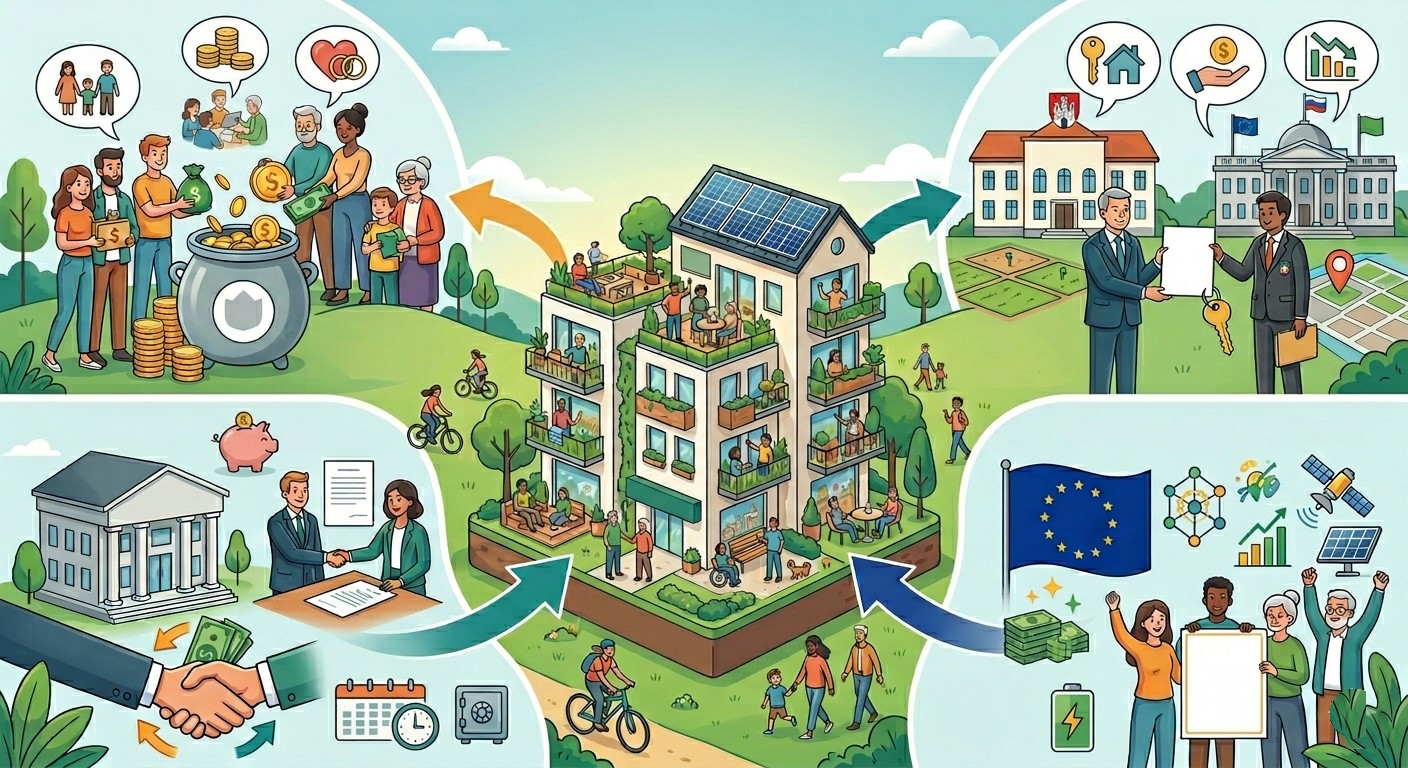
Housing cooperatives are becoming an increasingly popular alternative on the Slovenian market. It is a model where members build their own future – not just as individuals, but as a community. But how to finance such a project at all? The path to your own home through a cooperative is based on a smart combination of your own resources and external support. Here are four key pillars of funding.
Members’ own contributions: The foundation of stability
A housing cooperative is not a “free” apartment. It is an investment where members are both owners and users. Each member enters the cooperative with a certain input. These can be:
- Input inputs to cover initial costs (preparation of documentation, land).
- Cooperative shares, which are paid up by members gradually.
- Tangible property, such as land that a member contributes to a joint project.
Bank loans: Finding partners for the long term
For major construction projects, loans are a necessity. In Slovenia, this is still the biggest challenge, as banks find it difficult to recognize the non-profit cooperative model. The solution lies in:
- Project financing: Banks look at the business plan of the project and not just the creditworthiness of the individual.
- Ethical banking: More and more financial institutions are supporting projects with a social and environmental note.
- Guarantee schemes: The inclusion of state guarantees (e.g. through SID banks) is key to reducing interest rates.
Municipal and State Support: The Key to Accessibility
Housing cooperatives need “momentum.” Municipalities are key here, because with a little goodwill, they can drastically reduce construction costs:
- Grant of building rights: The municipality leases the land to the cooperative for a long-term lease, which means that the cooperative does not have to buy expensive land in the city center.
- Municipal Contribution Waiver: This is often the heaviest cost in construction, where municipal support can mean the difference between the success and failure of a project.
European calls and funds: For a green and sustainable future
The European Union, through various funds (such as ERDF and LIFE), strongly supports projects that are energy-efficient and socially inclusive. If your cooperative plans to build to the highest ecological standards, the door opens up to grants that can cover a significant part of the investment costs.
Participation is free, the number of places is limited – register as soon as possible!
Registration and information: epeka@epeka.si
Where? EPEKA Association, Tyrševa ulica 15, Maribor, at 5:00 p.m.
The EPEKA Youth Programme is co-financed by: the Youth Office of the Republic of Slovenia and the Municipality of Maribor