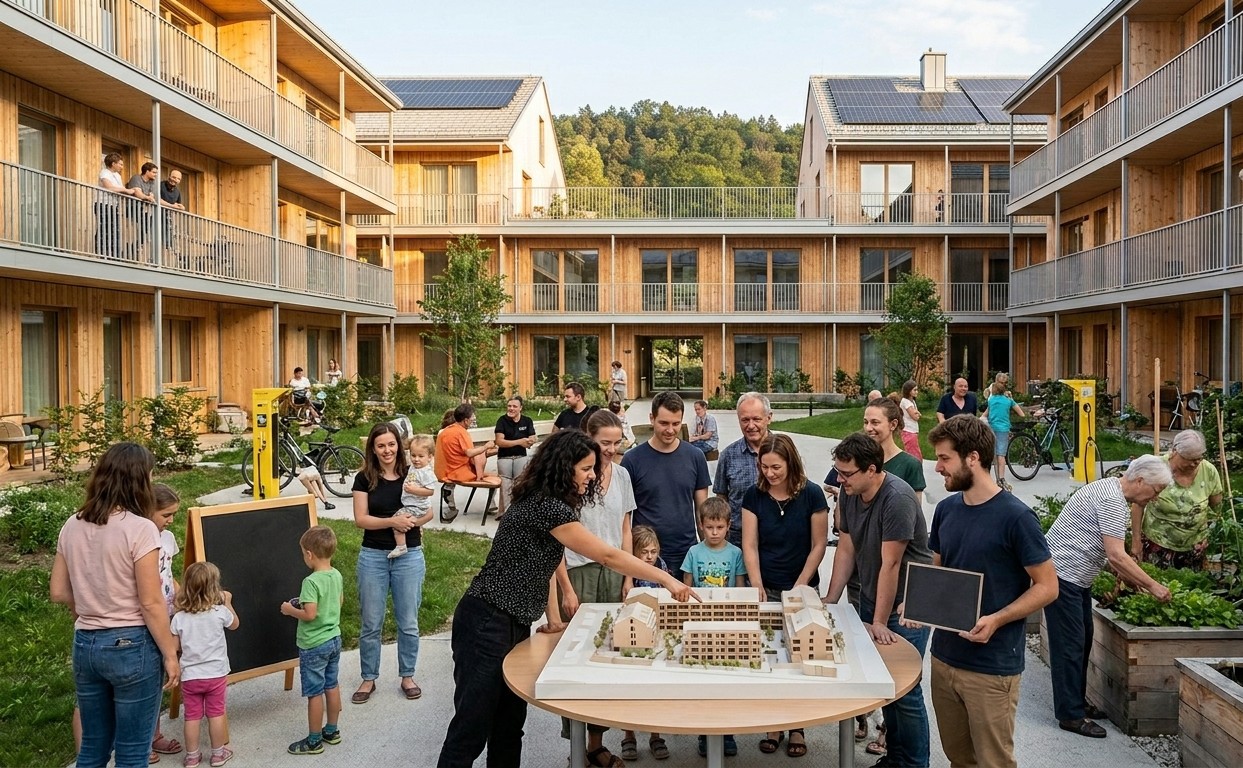
Sign up for the second workshop, which will be led by architect and lecturer Ubran Žunko. We continue with workshops that address the problems of young people in obtaining housing. This time we will discuss the concept of housing cooperatives, which in the future can concretely help to solve this problem.
At a time when real estate and rental prices in Slovenia have reached record levels, traditional models (full ownership or commercial rental) are becoming less and less affordable. Housing cooperatives offer a third way – a model where housing is not just a commodity for speculation, but a place to live and co-create. At this event, we will explore how cooperatives can change Slovenian housing.
- What is a housing cooperative? (Basic concept)
A housing cooperative is a non-profit organization established by residents with the purpose of building, acquiring or managing housing.
- Key principles: Democratic governance (one member, one vote), absence of profit as the main motive, long-term stability and collective ownership.
- Vision: Housing remains permanently affordable as it is exempt from the speculative market.
- Comparative Analysis: Ownership vs. Rent vs. Cooperative
We will explore where exactly the cooperative model fits into the existing system:
- Ownership: High capital investment, personal risk, but complete autonomy.
- Rental (commercial): No investment in the property, but high uncertainty and costs that enrich the owner.
- Cooperative stay: “Middle way” – payment of a contribution to the cooperative (but not the full market price), lower monthly rent (covering only the costs of maintenance and repayment of loans), the right to a lifetime residence and influence on decision-making.
- Advantages and disadvantages of the model
Advantages:
- Affordability (rents are 20-40% lower than market rents).
- Security (no fear of cancellation of the lease).
Community (spaces for socializing, intergenerational support).
Challenges:
- Complexity of establishment (a lot of knowledge is required).
- Financing (banks find it difficult to understand the model without classic ownership).
- The need for long-term commitment from members.
- Examples of good practices (abroad and starting with us)
- Zurich (Switzerland): Cooperatives as standard – almost a quarter of dwellings are owned by cooperatives (the example of the Kalkbreite neighbourhood).
- Vienna (Austria): How the city supports cooperative construction through land policy.
- Slovenian beginnings: Presentation of the efforts of the first Slovenian housing cooperatives (e.g. Housing Fund Cooperative), which are trying to pave the way on the domestic market.
Participation is free, the number of places is limited – register as soon as possible!
Registration and information: epeka@epeka.si
Where? EPEKA Association, Tyrševa ulica 15, Maribor, at 2:00 p.m.
The EPEKA Youth Programme is co-financed by: the Youth Office of the Republic of Slovenia and the Municipality of Maribor




POGLEJTE TUDI
You Might Also Like